qmunity (n): a neologism and portmanteau of "queer" and "community" used both as a community name and an individual identity
Example 1:
The qmunity is made up of many people who identify as bisexual, homosexual, transgender, or something akin to those things.
Example 2:
Person A: Is she qmunity?
Person B: Yep, she's qmunity; she's married to a lovely woman named Genevieve!
At present, many LGBT organizations are considering the implications of the continued use of the term "LGBT." They consider both the practical and ideological. On the practical level, they note that "LGBT" fails to recognize all of the aspects of lesbian, gay, bisexual, and/or transgender people; for instance, "LGBT" fails to recognize a butch identity or that a bisexual person may feel more attracted to one biosex than another. On the ideological level, some note how a delineated acronym de facto fails to identify the diversity said acronym attempts to include.
In order to address this problem, some have suggested that the LGBT people adopt the identity "queer" in order to be more inclusive. Some, including people both inside and outside the community, are uncomfortable with using the word "queer," citing the term's derogative history. Others, however, claim that adoption of the word "queer" is an act of reclamation, the process of changing the meaning of a pejorative term into one of positivity and community solidarity. For example, the words "nigger," "tranny," and "bitch" have all been (at least somewhat) reappropriated by some members of the black, transgender, and feminist communities.
Personally, I'm on the fence about reclaimation. The idea is beautiful, but I'm not convinced that it's working. One need look no further than ongoing cultural battles about the use of the word "nigger" and the difference between the words "nigger" and "nigga" to see that reclaimation is not perfect. To that end, I'm not totally on-board with the word "queer."
At the same time, I recognize that the term "LGBT" isn't perfect, and so I suggest a new word that attempts to utilize all of the inclusivity of the word "queer" but forgoes its questionable etymology - qmunity. "Qmunity" can be used both as the name of a community and as an individual's identity. Additionally, the word is pronounced as "kew-mew-nit-ee."

Showing posts with label LGBT. Show all posts
Showing posts with label LGBT. Show all posts
Tuesday, October 11, 2011

Thursday, August 25, 2011
Bisexual Erasure
Internet news sources have been ablaze this week with the stupidest, most pathetic headline of all time: "Bisexuals exist?!?!" Why yes, Virginia, yes they do, and fortunately, some news sources have captured the sheer absurdity of this "news" with their own clever headline responses, such as the New York Times' "No Surprise for Bisexual Men: Report Indicates They Exist" and Autostraddle's "Study Shows that Bisexual Men Exist, Bisexual People Not Surprised." While these cheeky headlines may be comical, the fact that they must be reported at all exposes a tragic reality: unfounded denialism of bisexuality is a real phenomenon, and bisexual people are suffering from it.
Denialism is the act of repudiating the existence of basic scientific truths, often because that truth violates an individual's worldview. Denialism is rather common, some of the most prevalent forms being Holocaust denialism, AIDS denialism, and global warming denialism, the latter being so contentious at present that the topic is often called "global warming controversy" instead of "denialism" by popular sources despite the fact that no organization of national or international professional standing has maintained a dissenting opinion. When denialism confronts bisexuality, that phenomenon is called bisexual erasure. Bisexual erasure is the tendency to ignore, remove, falsify, or re-explain evidence of bisexuality in real life, history and the news, and/or academia.
Bisexual erasure has many manifestations. It often takes the form of simply overlooking bisexuals, be the intention malicious or accidental. For instance, bisexuals call out how they are being overlooked in the marriage equality debate. (Ironically, that article comes from the Gay and Lesbian Task Force.) Indeed, the ongoing use of the terms such as "gay marriage" instead of "same-sex marriage" by proponents and opponents alike erases bi people by failing to recognize that not all people who desire to marry someone of the same sex are homosexual. The terms "gay or lesbian relationships" and "gay adoption" have similar problems of inclusivity and vercity. On an even more foundational level, the phrase "gay community" excludes bi people, as recently demonstrated by an exchange between news anchor Don Lemon and a trans activist at an NAACP forum, which is particularly intellectually-feeble given the definition of the word "community." (The specific topic of trans inclusion is a whole other ballgame, one that I'll be writing about soon.)
Bisexual erasure sometimes takes the form of doctoring historical information to exclude the possibility of bisexuality. Alexander the Great and Eleanor Roosevelt are commonly "straight-washed" or "gay-washed," when their personal histories clearly indicate bisexuality. Anne Frank's burgeoning interest in the bodies of men and women was famously redacted by her father in early printings for bierotic content. Even historical social institutions such as pederasty often have bisexuality removed from their modern descriptions; historic pederasty is categorized as "homosexual" when, in fact, the vast majority of pederasts (the older men who took younger male lovers) were married to women and fathered children with them, while their young lovers were expected to grow, marry women, and later become pederasts themselves.
In its most extreme form, bisexual erasure actually denies that bisexuality - and by extension bisexual people - exist. Unfortunately, my research finds that this kind of attitude is the most-prevalent form of bisexual erasure, meaning that bi people are most often subjected to the form of denialism that hurts most - the personal kind. This revocation of existence often takes on one of a few standard patterns. The most common pattern is monosexism, the fallacious notion that all people are either heterosexual or homosexual, nowhere inbetween. This ideology manifests itself in the strangest memes, among them the idea that bi people are gays "who are afraid to come out" or that they are really just inquisitive (and apparently hands-on!) straight people. A related view espoused more infamously in lesbian circles is the stereotype that bisexual women feign their bisexuality as a way of attracting male mates, and aren't "really" bisexual at all.
When erasure of bisexuality crosses the line between simple ignorance and pessimism about their character, bisexual erasure becomes the product of biphobia, the wider hatred, resentment, or aversion of bisexual people. Bi people have expressed that they are occassionally the targets of bigotry from both straight and gay detractors.
Malediction of bisexuals from gays has already been partially dicussed; however, there is more to develop. For gays, there is some research that indicates feelings of antipathy towards bi people from some their gay peers originates in a fallacy of accident on part of the latter: some homosexuals adopt bisexual identities as a transitional identity between the heterosexual identity assumed by cultural norm and their actual homosexual one, and, when they later transition from a bisexual identity to a homosexual one, they universalize their experience and thus assume that everyone with a bisexual identity is in the process of becoming gay. Thus, to a homosexual-identified person who has fallen for this fallacy, bisexuals do not exist. Unbelievably, I've heard this argument a lot from from gay-identified people I know, particularly from lesbian-identified women. The mythos of lesbians hating bi women is based in some truth: I recall a rather telling story of a local lesbian discussion group that ceased operation when new leadership suggested that the group's name be changed from Lesbian Chat to Women's Chat. Some members of the group - particularly older ladies - were furious that the proposed name change might suggest that the group welcomed bi women, and that was something those ladies simply couldn't accept! Likewise, pejorative gay community slang such as "lesbian until graduation," "hasbian," and "yestergay" expose other hurtful things bis endure from gay peers.
Malediction from their straight peers is, unfortunately, even more severe. In addition to all of the untrue and hurtful accusations orginating in gay communities about bi people, heterosexuals have had some particularly nasty (and unfounded) things to say about bisexuals. One of the most pervasive negative stereotypes about bisexual people is that they are "greedy." There is no scientific evidence to substanciate this claim. More dramatically, evangelists have infamously scapegoated bisexuals for transmitting HIV to heterosexuals. Epidemiologists have disproven this allegation by studying both the origin of HIV and the historical timeline of medical discovery.
The ignorant-to-hateful attitudes discussed here are behind the avowels against the existence of bisexuality found in the stupid headlines that began this discourse. (Wow, that was a Judith Butler sentence! Sorry, readers.) But the very idea that some researchers had to do a study to prove that people are truly experiencing the feelings they claim to feel is, frankly, pathetic. I mean, when was the last time you told someone, "I feel hungry" and they replied, "Hold on. I'll get my instruments to verify?" Never. And for that very reason - that we don't factcheck people's feelings because emotions are ineffable and understood to be a person's subjective truth - the fact that shit like this is newsworthy is both a total embarrassment and proof of the entrenched depths of bisexual erasure.
This blog wouldn't fulfill my definition of "positivistic" if it didn't offer practical solutions to problems. As the problem I present here is erasure of bisexuality, I suggest that you, dear reader (even if you are bi), undo some of that erasure by taking a few minutes to educate yourself about bisexuality. You could read about the history of the bisexual pride flag, literary depictions of bisexuals, watch a great It Gets Better Campaign video by the American Institute of Bisexuality, or even just see who's bisexual and famous. And make certain to check back here at Sexpertesse; next time, more on bisexuality!
 |
| How freaking excited are you for next week's episode, bi kids?! |
Denialism is the act of repudiating the existence of basic scientific truths, often because that truth violates an individual's worldview. Denialism is rather common, some of the most prevalent forms being Holocaust denialism, AIDS denialism, and global warming denialism, the latter being so contentious at present that the topic is often called "global warming controversy" instead of "denialism" by popular sources despite the fact that no organization of national or international professional standing has maintained a dissenting opinion. When denialism confronts bisexuality, that phenomenon is called bisexual erasure. Bisexual erasure is the tendency to ignore, remove, falsify, or re-explain evidence of bisexuality in real life, history and the news, and/or academia.
Bisexual erasure has many manifestations. It often takes the form of simply overlooking bisexuals, be the intention malicious or accidental. For instance, bisexuals call out how they are being overlooked in the marriage equality debate. (Ironically, that article comes from the Gay and Lesbian Task Force.) Indeed, the ongoing use of the terms such as "gay marriage" instead of "same-sex marriage" by proponents and opponents alike erases bi people by failing to recognize that not all people who desire to marry someone of the same sex are homosexual. The terms "gay or lesbian relationships" and "gay adoption" have similar problems of inclusivity and vercity. On an even more foundational level, the phrase "gay community" excludes bi people, as recently demonstrated by an exchange between news anchor Don Lemon and a trans activist at an NAACP forum, which is particularly intellectually-feeble given the definition of the word "community." (The specific topic of trans inclusion is a whole other ballgame, one that I'll be writing about soon.)
Bisexual erasure sometimes takes the form of doctoring historical information to exclude the possibility of bisexuality. Alexander the Great and Eleanor Roosevelt are commonly "straight-washed" or "gay-washed," when their personal histories clearly indicate bisexuality. Anne Frank's burgeoning interest in the bodies of men and women was famously redacted by her father in early printings for bierotic content. Even historical social institutions such as pederasty often have bisexuality removed from their modern descriptions; historic pederasty is categorized as "homosexual" when, in fact, the vast majority of pederasts (the older men who took younger male lovers) were married to women and fathered children with them, while their young lovers were expected to grow, marry women, and later become pederasts themselves.
 |
| Alexander was a terrible movie. But Colin Farrell! Actress Angelina Jolie is bisexual. And Colin Farrell! |
In its most extreme form, bisexual erasure actually denies that bisexuality - and by extension bisexual people - exist. Unfortunately, my research finds that this kind of attitude is the most-prevalent form of bisexual erasure, meaning that bi people are most often subjected to the form of denialism that hurts most - the personal kind. This revocation of existence often takes on one of a few standard patterns. The most common pattern is monosexism, the fallacious notion that all people are either heterosexual or homosexual, nowhere inbetween. This ideology manifests itself in the strangest memes, among them the idea that bi people are gays "who are afraid to come out" or that they are really just inquisitive (and apparently hands-on!) straight people. A related view espoused more infamously in lesbian circles is the stereotype that bisexual women feign their bisexuality as a way of attracting male mates, and aren't "really" bisexual at all.
When erasure of bisexuality crosses the line between simple ignorance and pessimism about their character, bisexual erasure becomes the product of biphobia, the wider hatred, resentment, or aversion of bisexual people. Bi people have expressed that they are occassionally the targets of bigotry from both straight and gay detractors.
Malediction of bisexuals from gays has already been partially dicussed; however, there is more to develop. For gays, there is some research that indicates feelings of antipathy towards bi people from some their gay peers originates in a fallacy of accident on part of the latter: some homosexuals adopt bisexual identities as a transitional identity between the heterosexual identity assumed by cultural norm and their actual homosexual one, and, when they later transition from a bisexual identity to a homosexual one, they universalize their experience and thus assume that everyone with a bisexual identity is in the process of becoming gay. Thus, to a homosexual-identified person who has fallen for this fallacy, bisexuals do not exist. Unbelievably, I've heard this argument a lot from from gay-identified people I know, particularly from lesbian-identified women. The mythos of lesbians hating bi women is based in some truth: I recall a rather telling story of a local lesbian discussion group that ceased operation when new leadership suggested that the group's name be changed from Lesbian Chat to Women's Chat. Some members of the group - particularly older ladies - were furious that the proposed name change might suggest that the group welcomed bi women, and that was something those ladies simply couldn't accept! Likewise, pejorative gay community slang such as "lesbian until graduation," "hasbian," and "yestergay" expose other hurtful things bis endure from gay peers.
Malediction from their straight peers is, unfortunately, even more severe. In addition to all of the untrue and hurtful accusations orginating in gay communities about bi people, heterosexuals have had some particularly nasty (and unfounded) things to say about bisexuals. One of the most pervasive negative stereotypes about bisexual people is that they are "greedy." There is no scientific evidence to substanciate this claim. More dramatically, evangelists have infamously scapegoated bisexuals for transmitting HIV to heterosexuals. Epidemiologists have disproven this allegation by studying both the origin of HIV and the historical timeline of medical discovery.
The ignorant-to-hateful attitudes discussed here are behind the avowels against the existence of bisexuality found in the stupid headlines that began this discourse. (Wow, that was a Judith Butler sentence! Sorry, readers.) But the very idea that some researchers had to do a study to prove that people are truly experiencing the feelings they claim to feel is, frankly, pathetic. I mean, when was the last time you told someone, "I feel hungry" and they replied, "Hold on. I'll get my instruments to verify?" Never. And for that very reason - that we don't factcheck people's feelings because emotions are ineffable and understood to be a person's subjective truth - the fact that shit like this is newsworthy is both a total embarrassment and proof of the entrenched depths of bisexual erasure.
This blog wouldn't fulfill my definition of "positivistic" if it didn't offer practical solutions to problems. As the problem I present here is erasure of bisexuality, I suggest that you, dear reader (even if you are bi), undo some of that erasure by taking a few minutes to educate yourself about bisexuality. You could read about the history of the bisexual pride flag, literary depictions of bisexuals, watch a great It Gets Better Campaign video by the American Institute of Bisexuality, or even just see who's bisexual and famous. And make certain to check back here at Sexpertesse; next time, more on bisexuality!
 |
| Bi is beautiful. |
Sunday, August 21, 2011
The Wicked Awesome History of Marriage Equality in New Jersey
Do yous like Jeerzy? Well, hopefully you're not a lesbian looking to buy a wedding dress.
Daily News coloumnist Ronnie Polaneczky writes an apologetic human interest story about a young bride-to-be who was denied service by a bridal store because she is a lesbian. "Apologetic?" you ask? Well, yes; thoughtful and kind-hearted straight person Polaneczky, aftering learning all the facts about what happened to Alix Genter (the bride-to-be) and then speaking to Donna (the bridal store owner/service-denier), ultimately finds that he is really, really sorry Genter has to put up with this kind of crap. "...stories [like this one]... make me want to say 'I'm sorry' to gay people for the nonsense they endure from some heterosexuals who give the rest of us straight people a bad name."
Polaneczky is a reasonable person who logically interprets facts about LGBT people, so there's no real reason for me to address his positions. The bridal store owner Donna, however... well, let's just say that I suspect she lives at 1234 Under a Boulder Boulevard, if you know what I mean. I think now would be a great time to educate Donna about how her opinions about LGBT people are a tad off-base.
Donna said a lot of tragically-underinformed, hurtful things about LGBT people in her interview with Polaneczky, including that Genter is a lesbian only because men let her down and thus she relegated herself to women, that LGBT people love to "stir up drama," and that they are crazy aggressors who... plundge knives into restaurant chairs? Yeah, I don't get it, either. However, none of these sentiments were as out-of-touch with reality than her comments about the recognition of same-sex marriage in her state of New Jersey.
The most interesting part of the whole story is why Donna refused to serve Genter. When Donna called Genter to refuse the latter's business, Donna explained that she refused service because 'what Genter was planning' (i.e., her wedding) was "illegal," and that Donna does "not participate in illegal activities." Well, isn't that upstanding of you, Donna? Except for the fact that civil unions have been legal in your state of New Jersey since 19 February 2007, when the Civil Union Act went into effect.
Prior to the passing of that bill by the New Jersey Legislature, there was a five-year-long, highly-publicized New Jersey Supreme Court case called Lewis v. Harris that questioned New Jersey's legal authority to deny the protections and responsibilities of marriage to same-sex couples. Lambda Legal filed Lewis v. Harris in June 2002 on behalf of seven same-sex couples seeking to wed in New Jersey: Mark Lewis and Dennis Winslow, Cindy Meneghin and Maureen Kilian, Craig Hutchison and Chris Lodewyks, Diane Marini and the late Marilyn Maneely, Marcye and Karen Nicholson-McFadden, Saundra Toby-Heath and Alicia Heath-Toby, and Sarah and Suyin Lael. When the case reached the state's Supreme Court, the Justices found unanimously that denying same-sex couples the same legal rights and benefits opposite-sex couples enjoy through marriage violated the state's Constitution. However - and this is the really interesting part - even though the Court found that it is illegal to deny marriage benefits to same-sex couples, the Court didn't actually grant marriage equality. Instead, the Justiced demanded that the Legislature pass legislation making opposite and same-sex couples legally-equal within 180 days. The Legislature did so, and thus the Civil Unions Act was passed and signed into law by then-Governor Jon Corzine. So, Donna, your choice to deny Genter on the basis that her actions are illegal, then, was a legally-unfounded claim, and the long history of that fact should have been apparent to you as a resident of New Jersey. The fact that you live at 1234 Under a Boulder Boulevard notwithstanding, of course.
As further proof that Donna's residence at 1234 Under a Boulder Boulevard is somehow the most remote location in the state with the higest population density in the Union with 1,196 inhabitants per square mile, Donna seems to be totally clueless about the legal recognition of same-sex relationships in her state despite the fact that New Jersey is one of the two most-heated hotspots for marriage equality at present! (The other one is California with it's ongoing legal battles over Perry v. Schwarzenegger.) Before the passage of the New Jersey Civil Unions Act, Lambda Legal had already reviewed the bill's content, and found that it would not actually provide all of the same rights as marriage and established their "Civil Unions Watch" in response. The New Jersey Bar Association came to the same conclusion shortly thereafter. Oh, and New Jerseyans noticed, too: by July 2007 - less than six months after the bill's ratification - 211 of the 1,358 couples unionized under the law reported to Garden State Equality that they had been denied full legal equality under civil unions.
Fortunately for these couples, the Civil Unions Act had already formed a group of legislators tasked with monitaring civil unions, the Civil Unions Review Commission. Since their first meeting on 18 June 2007, the Commission collected complaints from same-sex couples about the state's civil unions and, in December 2008, they released their finding that civil unions don't actually provide full legal equality to same-sex couples mandated by Lewis v. Harris; likewise, the Commission recommended that the New Jersey Legislature change the language of existing marriage laws to be gender-neutral so as to include same-sex couples.
In December 2009 - a full year after the Commission's recommendations - the New Jersey Senate Judiciary Committee voted to approve marriage equality in a 7 to 6 vote. The Senate at large, however, defeated the measure 20 to 14, and thus marriage equality was not brought to New Jersey.
But there are no excuses for you to be so unaware of this news, Donna, for the story continues! In January 2010, Republican Chris Christie assume the position of Governor by defeating incumbent governor Corzine; whereas Corzine had said he would sign marriage equality into law should a bill come to his desk, current Governor Christie supports a constitutional amendment barring same-sex couples for marriage. (For those of you who are really following, yes, the current Governor of New Jersey supports legislation that would withhold legal equality to same-sex couples despite the fact that the state's Supreme Court already ruled that doing so violates the state's constitution and the Civil Union Review Commission declared that they couldn't hold out on equality much longer. Some might say that Christie is aloof or a little... out of his mind; but I disagree, for Christie is clearly not tremendously fond of the rules or your stupid opinions, so this kind of feeble thinking is par for the course for him.) Christie's position on marriage equality means that it's highly unlikely the recommendations of the Civil Union Review Commission will become law through the legislative process.
Likewise, in March 2010, Lambda Legal filed a motion reactivating the case for marriage equality on behalf of the plaintiffs in the original Lewis v. Harris lawsuit, meaning that the state of New Jersey, which is in a pretty serious budget crisis and Christie subsequently underfunded public schools through budget cuts before said cuts were found to be illegal by a district judge, must pay again to rehash an issue that was already decided upon several years ago by the Supreme Court of that state! There is a silver lining for gay and bisexual New Jerseyans, however: this time, the Supreme Court will have to recognize the equalness of your relationships, as they tasked the legislative branch to enact that truth and the Legislature failed to do so, so the Court will have to pick up the slack. Equality will come to you soon, at least at the state level.
With all of this money and all these weddings at stake, you'd think that Donna, who makes her living by selling wedding attire, would be a little more cognisant of the suffering of gays and bisexuals in your state. Now, Donna, listen up, cuz this is very important to your livelihood: according to a 2006 study by The Williams Institute on Sexual Orientation Law and Public Policy, if marriage equality was to become law in New Jersey, "sales by... wedding and tourism-related business would rise by $102.5 million in each of the three years" following the legalization of same-sex marriage. Additionally, New Jersey's gross tax revenue would "rise by $7.2 million per year," and some 1,400 jobs would be created in your state. Yes, that's $307.5 million pumped into your business in the next three years. You'd have to be crazy to turn down that kind of money, Donna. Then again, it's clearly very remote out there at 1234 Under a Boulder Boulevard and, to use your own words, "You know how they get."
Daily News coloumnist Ronnie Polaneczky writes an apologetic human interest story about a young bride-to-be who was denied service by a bridal store because she is a lesbian. "Apologetic?" you ask? Well, yes; thoughtful and kind-hearted straight person Polaneczky, aftering learning all the facts about what happened to Alix Genter (the bride-to-be) and then speaking to Donna (the bridal store owner/service-denier), ultimately finds that he is really, really sorry Genter has to put up with this kind of crap. "...stories [like this one]... make me want to say 'I'm sorry' to gay people for the nonsense they endure from some heterosexuals who give the rest of us straight people a bad name."
Polaneczky is a reasonable person who logically interprets facts about LGBT people, so there's no real reason for me to address his positions. The bridal store owner Donna, however... well, let's just say that I suspect she lives at 1234 Under a Boulder Boulevard, if you know what I mean. I think now would be a great time to educate Donna about how her opinions about LGBT people are a tad off-base.
Donna said a lot of tragically-underinformed, hurtful things about LGBT people in her interview with Polaneczky, including that Genter is a lesbian only because men let her down and thus she relegated herself to women, that LGBT people love to "stir up drama," and that they are crazy aggressors who... plundge knives into restaurant chairs? Yeah, I don't get it, either. However, none of these sentiments were as out-of-touch with reality than her comments about the recognition of same-sex marriage in her state of New Jersey.
The most interesting part of the whole story is why Donna refused to serve Genter. When Donna called Genter to refuse the latter's business, Donna explained that she refused service because 'what Genter was planning' (i.e., her wedding) was "illegal," and that Donna does "not participate in illegal activities." Well, isn't that upstanding of you, Donna? Except for the fact that civil unions have been legal in your state of New Jersey since 19 February 2007, when the Civil Union Act went into effect.
Prior to the passing of that bill by the New Jersey Legislature, there was a five-year-long, highly-publicized New Jersey Supreme Court case called Lewis v. Harris that questioned New Jersey's legal authority to deny the protections and responsibilities of marriage to same-sex couples. Lambda Legal filed Lewis v. Harris in June 2002 on behalf of seven same-sex couples seeking to wed in New Jersey: Mark Lewis and Dennis Winslow, Cindy Meneghin and Maureen Kilian, Craig Hutchison and Chris Lodewyks, Diane Marini and the late Marilyn Maneely, Marcye and Karen Nicholson-McFadden, Saundra Toby-Heath and Alicia Heath-Toby, and Sarah and Suyin Lael. When the case reached the state's Supreme Court, the Justices found unanimously that denying same-sex couples the same legal rights and benefits opposite-sex couples enjoy through marriage violated the state's Constitution. However - and this is the really interesting part - even though the Court found that it is illegal to deny marriage benefits to same-sex couples, the Court didn't actually grant marriage equality. Instead, the Justiced demanded that the Legislature pass legislation making opposite and same-sex couples legally-equal within 180 days. The Legislature did so, and thus the Civil Unions Act was passed and signed into law by then-Governor Jon Corzine. So, Donna, your choice to deny Genter on the basis that her actions are illegal, then, was a legally-unfounded claim, and the long history of that fact should have been apparent to you as a resident of New Jersey. The fact that you live at 1234 Under a Boulder Boulevard notwithstanding, of course.
As further proof that Donna's residence at 1234 Under a Boulder Boulevard is somehow the most remote location in the state with the higest population density in the Union with 1,196 inhabitants per square mile, Donna seems to be totally clueless about the legal recognition of same-sex relationships in her state despite the fact that New Jersey is one of the two most-heated hotspots for marriage equality at present! (The other one is California with it's ongoing legal battles over Perry v. Schwarzenegger.) Before the passage of the New Jersey Civil Unions Act, Lambda Legal had already reviewed the bill's content, and found that it would not actually provide all of the same rights as marriage and established their "Civil Unions Watch" in response. The New Jersey Bar Association came to the same conclusion shortly thereafter. Oh, and New Jerseyans noticed, too: by July 2007 - less than six months after the bill's ratification - 211 of the 1,358 couples unionized under the law reported to Garden State Equality that they had been denied full legal equality under civil unions.
Fortunately for these couples, the Civil Unions Act had already formed a group of legislators tasked with monitaring civil unions, the Civil Unions Review Commission. Since their first meeting on 18 June 2007, the Commission collected complaints from same-sex couples about the state's civil unions and, in December 2008, they released their finding that civil unions don't actually provide full legal equality to same-sex couples mandated by Lewis v. Harris; likewise, the Commission recommended that the New Jersey Legislature change the language of existing marriage laws to be gender-neutral so as to include same-sex couples.
In December 2009 - a full year after the Commission's recommendations - the New Jersey Senate Judiciary Committee voted to approve marriage equality in a 7 to 6 vote. The Senate at large, however, defeated the measure 20 to 14, and thus marriage equality was not brought to New Jersey.
But there are no excuses for you to be so unaware of this news, Donna, for the story continues! In January 2010, Republican Chris Christie assume the position of Governor by defeating incumbent governor Corzine; whereas Corzine had said he would sign marriage equality into law should a bill come to his desk, current Governor Christie supports a constitutional amendment barring same-sex couples for marriage. (For those of you who are really following, yes, the current Governor of New Jersey supports legislation that would withhold legal equality to same-sex couples despite the fact that the state's Supreme Court already ruled that doing so violates the state's constitution and the Civil Union Review Commission declared that they couldn't hold out on equality much longer. Some might say that Christie is aloof or a little... out of his mind; but I disagree, for Christie is clearly not tremendously fond of the rules or your stupid opinions, so this kind of feeble thinking is par for the course for him.) Christie's position on marriage equality means that it's highly unlikely the recommendations of the Civil Union Review Commission will become law through the legislative process.
Likewise, in March 2010, Lambda Legal filed a motion reactivating the case for marriage equality on behalf of the plaintiffs in the original Lewis v. Harris lawsuit, meaning that the state of New Jersey, which is in a pretty serious budget crisis and Christie subsequently underfunded public schools through budget cuts before said cuts were found to be illegal by a district judge, must pay again to rehash an issue that was already decided upon several years ago by the Supreme Court of that state! There is a silver lining for gay and bisexual New Jerseyans, however: this time, the Supreme Court will have to recognize the equalness of your relationships, as they tasked the legislative branch to enact that truth and the Legislature failed to do so, so the Court will have to pick up the slack. Equality will come to you soon, at least at the state level.
With all of this money and all these weddings at stake, you'd think that Donna, who makes her living by selling wedding attire, would be a little more cognisant of the suffering of gays and bisexuals in your state. Now, Donna, listen up, cuz this is very important to your livelihood: according to a 2006 study by The Williams Institute on Sexual Orientation Law and Public Policy, if marriage equality was to become law in New Jersey, "sales by... wedding and tourism-related business would rise by $102.5 million in each of the three years" following the legalization of same-sex marriage. Additionally, New Jersey's gross tax revenue would "rise by $7.2 million per year," and some 1,400 jobs would be created in your state. Yes, that's $307.5 million pumped into your business in the next three years. You'd have to be crazy to turn down that kind of money, Donna. Then again, it's clearly very remote out there at 1234 Under a Boulder Boulevard and, to use your own words, "You know how they get."
Monday, April 18, 2011
Responce to "List of Cisgender Privileges"
The other day, a friend and transgender activist posted a "List of Cisgender Privilages" that she had found online. This list, a notable transgender meme, was supposedly inspired by "White Privilege: Unpacking the Invisible Knapsack," a shortened form of feminist and anti-racist scholar and activist Peggy McIntosh's 1988 essay "White Privilege and Male Privilege: a Personal Account of Coming to See Correspondences through Work in Women's Studies." This latter work, though at present a tad dated, is a serious player in Gender Studies circles, and McIntosh is a well-respected figure.
This list inspired by her work, though, isn't as brilliant. To the positive, the list - which I will post here and to which I will respond line-by-line - makes some solid and impactful assessments; to the negative, though, it makes just as many half-baked ones, which neither further the movement for social equality and justice for transgender people nor paints a totally-accurate account of their realities.
The author of this particular list is unknown. Additionally, what I like about said list is that it looks upon cisgender people as the subject. Too often, non-heteronormative people are studied and scrutinized as the "other," meaning that almost all research fails to look back and study the majority. This list attempts to undo this problem by studying the majority, something expertly suggested by Toni Morrison in her 1992 piece Playing in the Dark: Whiteness and the Literary Imagination.
This list inspired by her work, though, isn't as brilliant. To the positive, the list - which I will post here and to which I will respond line-by-line - makes some solid and impactful assessments; to the negative, though, it makes just as many half-baked ones, which neither further the movement for social equality and justice for transgender people nor paints a totally-accurate account of their realities.
The author of this particular list is unknown. Additionally, what I like about said list is that it looks upon cisgender people as the subject. Too often, non-heteronormative people are studied and scrutinized as the "other," meaning that almost all research fails to look back and study the majority. This list attempts to undo this problem by studying the majority, something expertly suggested by Toni Morrison in her 1992 piece Playing in the Dark: Whiteness and the Literary Imagination.
Tuesday, April 12, 2011
Out Magazine's Disrespectful Power 50 List
Today, Out Magazine released their fifth annual Power 50, a list they compile of the fifty most-“power[ful] and talent[ed].” Having the largest monthly circulation of any LGBT periodical with 203,000 copies per month, Out is arguably a major player in LGBT news, identity, and community. It is both disappointing and hurtful, then, that four of the top ten featured individuals are not outly lesbian, gay, bisexual, or transgender.
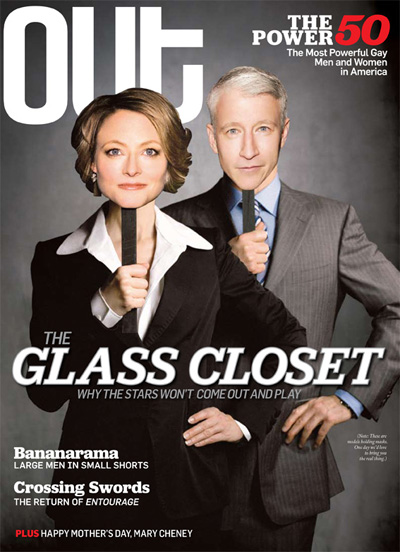
Placed this year at number three, Anderson Cooper. Cooper’s place on the list is not in question – after all, he headed the late-2010 national media coverage on the series of suicides by young LGBT people due to bullying; he closelined anti-gay, totally-delusional bigot Andrew Shirvell on stalking and bullying the gay Student-body President of the University of Michigan; and he’s obviously gay. (Thanks, Kathy Griffin!) What is in question, though, is Out’s decision to place him on the top ten, for though he may be very influential and attractive, Anderson Cooper is not out. Unbelievably, Cooper beat out Rachel Maddow, an equally-influential political commentator who is actually brave enough to be open about her lesbianism. (Maddow came in at number four, one spot behind Cooper.)

At number six is Shepard Smith, the longstanding Fox News host of Fox Report with Shepard Smith. Smith’s position on the list is utterly, completely baffling. None of Smith’s official bios note that he is gay or bi; said bios do, however, note that he was once married to a college classmate (a woman) and that the pair divorced in 1993! To add insult to injury, Smith’s show frequently features anti-gay zealots such as Mike Huckabee and Maggie Gallagher. But there are a lot of internet rumors about Smith’s sexuality, aren’t there, Out? So that totally makes his inclusion logical!

Peter Theil, American entrepreneur, hedge fund manager, and Libertarian (aka Ron Paul enthusiast), is number seven. Like Anderson Cooper, Thiel’s inclusion on the list isn’t a complete mystery, for he has supported the American Foundation for Equal Rights and GoProud. However, like the previous two entries, Theil is not out, and may not even be LGBT.

Finally, Barry Diller is number 8. Diller is a very wealthy media executive; indeed, as the list focuses on power, Diller has plenty to go around. His inclusion on Out’s list though, is built entirely on gay rumors began by Andy Warhol, who you can totally believe because he is well-known for telling the truth. Apparently, lots of people assumed that Diller is gay, and ergo he deserves to be on Out’s list. That’s some integrity-filled compiling, Out Magazine!
What upsets me most about Out’s list if the lack of respect for LGBT people found within it. By placing four individuals who are not out, maybe not even LGBT, and not specifically straight allies of the community within the top ten, Out asserts that out LGBT people aren’t worthy of being on a list specifically-designed to celebrate them. Instead, the message that Out’s line-up sends is, “Yeah, confident and brave out LGBT activist, you might be working hard to achieve equality, but you’re not as good as these two closet cases, a really rich guy who some crazy artist wanted to be gay, and a Fox News commentator. They’re the REAL LGBT powerhouses.” Put simply, Out, fuck you.
Out’s actions continue the meme that LGBT people are unworthy, that they deserve to be second-class citizens, that they don’t deserve self-respect and community pride. As an LGBT periodical, Out’s very purpose should be to fight this kind if ideology; Out, however, seemingly disagrees, human dignity be damned.
Sunday, January 16, 2011
Hero: Beth Ditto
Sexpertesse occassionally will feature heroes, people who embody the humanistic principles of this blog. My first hero is the beautiful, talented, and wise Beth Ditto.

Ditto is also an inspiration to trans people and their partners; Ditto's partner Freddie is transgender-identified, having transitioned from female-to-male. He and Ditto have been together supposedly since before his transition. Ditto, then, is a rare notable example of a lesbian-identified woman whose partner transitioned into a man. (Though you ladies might have guessed it, Ditto identifies as a femme.)
Given her outness, then, it might come as a suprise that the controversies that surround Ditto don't focus on her sexuality nor her feminist causes, but instead on her weight. Yeah, you read that correctly: in countries where the status and human-ness of LGBT people are under constant scrutiny (and sometimes up to popular vote), the part that really irks people about Ditto is the size of her waist.
Some, including Alex Bilmes of GQ, have criticized Ditto's weight, claiming her media exposure normalizes unhealthy weights. Ditto's weight has also encircled her success as a fashion icon. Appearing in numerous fashion magazines and runway shows, Ditto is arguably the only fullfigured fashion icon. Marie O’Riordan, former editor of Marie Claire, suggests that Ditto is used by the fashion indstury as a human shield against criticism of their size 0 standard. Ditto, thus, O'Riordan claims, is the fashion industry's attempt to avoid being labeled "body fascists." My questions is, though, does it much matter? No matter their intention in hiring Ditto, she still appears on covers, in spreads, and on runways, meaning, invariably, that some young voluptuous person will see her picture and think, "She's beautiful, and so am I," and thus Ditto's body-positive messages are reaching the very people who need them most.
In light of these criticisms, though, Ditto remains dignified, saying, "It's really interesting to me that people will look at a thin person and go, 'That's a healthy person.' To be thin and to stay really thin, some people literally do coke all the time. Some people smoke cigarettes instead of eating. That's crazy. But that's 'okay' because you look healthier." In 2009, Ditto also expanded her body-positive message by releasing a fashion line with Evans, the UK-based plus-size fashion designer and retailer. For readers in the EU, you can purchase some of Ditto's designs by visiting Evans, located here.

"I got my period just 10 minutes before we got there, and I was totally bleeding. I was doing it with my tranny boyfriend, who I’m in love with, and I was totally bleeding — how radical is that? — and I’m a fat person, and I’m a femme." - Beth Ditto about her NME photo shootBeth Ditto is best known as the leader singer of the indie rock, queercore group Gossip. With Gossip, Ditto is an unwavering advocate for LGBT rights and feminist causes. Ditto, who is a lesbian, tackled many LGBT and feminist issues during her stint as an advice columnist for The Guardian. You can read her column, What Would Beth Ditto do?, by clicking here.
Ditto is also an inspiration to trans people and their partners; Ditto's partner Freddie is transgender-identified, having transitioned from female-to-male. He and Ditto have been together supposedly since before his transition. Ditto, then, is a rare notable example of a lesbian-identified woman whose partner transitioned into a man. (Though you ladies might have guessed it, Ditto identifies as a femme.)
 |
| Beth Ditto and her partner Freddie |
Given her outness, then, it might come as a suprise that the controversies that surround Ditto don't focus on her sexuality nor her feminist causes, but instead on her weight. Yeah, you read that correctly: in countries where the status and human-ness of LGBT people are under constant scrutiny (and sometimes up to popular vote), the part that really irks people about Ditto is the size of her waist.
Some, including Alex Bilmes of GQ, have criticized Ditto's weight, claiming her media exposure normalizes unhealthy weights. Ditto's weight has also encircled her success as a fashion icon. Appearing in numerous fashion magazines and runway shows, Ditto is arguably the only fullfigured fashion icon. Marie O’Riordan, former editor of Marie Claire, suggests that Ditto is used by the fashion indstury as a human shield against criticism of their size 0 standard. Ditto, thus, O'Riordan claims, is the fashion industry's attempt to avoid being labeled "body fascists." My questions is, though, does it much matter? No matter their intention in hiring Ditto, she still appears on covers, in spreads, and on runways, meaning, invariably, that some young voluptuous person will see her picture and think, "She's beautiful, and so am I," and thus Ditto's body-positive messages are reaching the very people who need them most.
 |
| Ditto at Paris Fashion Week for Spring 2011 collections |
Ditto's fearless acceptance of her body, her sexuality, her trans partner; her commitment to body positivism and equal rights; and her rocking style make her a Sexpertesse hero. Please support her by purchasing music by The Gossip or her 2011 solo EP on Amazon or iTunes. The world needs more people like Beth Ditto, and her continued success in music is what permits her to have a relevant voice.
Subscribe to:
Posts (Atom)